
China-Africa trade relations have undergone a profound transformation over the past decade, from an infrastructure partnership to a more diversified relationship centered on green energy technology, critical minerals, and universal market access. In 2025, China emerged as the single largest source of foreign direct investment (FDI) backing Africa’s biggest new development projects, committing nearly USD 4.7 billion across top-tier mega-developments. Total bilateral trade between China and Africa reached USD 348.05 billion in 2025, a 17.7% year-on-year increase.
2026 marked another major milestone in the history of China-Africa relations. On May 1, 2026, China announced a comprehensive zero-tariff policy covering all 53 African countries with formal diplomatic ties to Beijing. The framework extends universal, non-reciprocal zero-tariff treatment to these countries, removing trade barriers that previously restricted value-added exports and giving African producers a more competitive edge in the massive Chinese consumer market.
It is more crucial than ever for African businesses to contemplate strategic export diversification, local value-addition, and active commercial engagement with Chinese distribution networks to capture the immense growth opportunities unlocked by this new era of duty-free trade.
Complementing the trade opening, Hong Kong offers a strategic base from which African businesses can leverage when structuring business operations in China. Our article explores how Hong Kong’s distinct advantages act as a premier “super-connector” for African enterprises managing cross-border trade, capital structuring, and corporate expansion into the broader mainland market.
Watch the webinar: Unlocking China
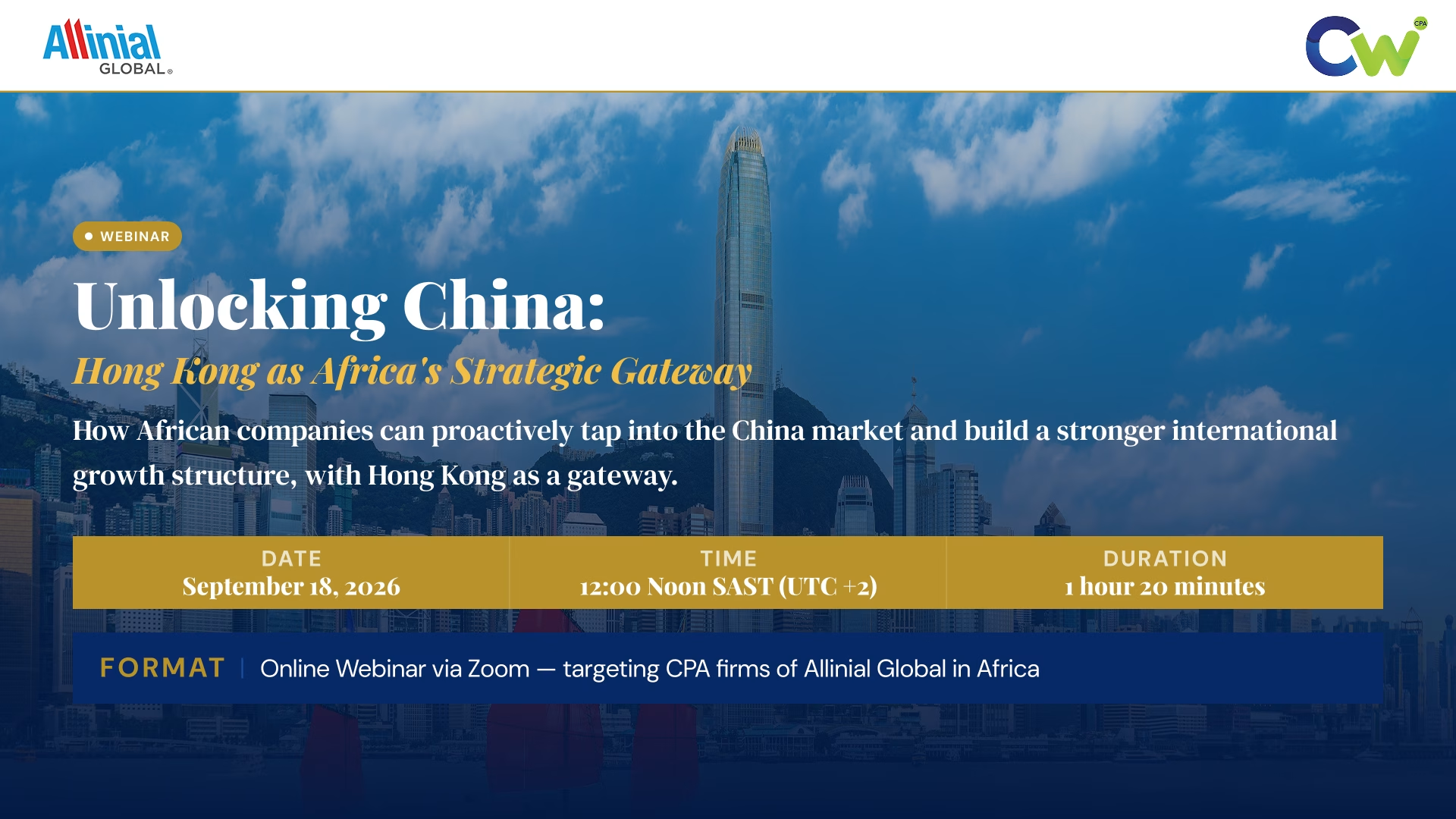
How can African companies use Hong Kong to develop business with China? In Unlocking China: Hong Kong as Africa’s Strategic Gateway, CW CPA’s Thomas Wong explores trading structures, financing, commercial partnerships and the networks connecting African businesses with the Chinese market.
Hong Kong’s Structural Advantages
Hong Kong is situated on China’s southern coast adjacent to the Guangdong-Hong Kong-Macao Greater Bay Area, with a population of approximately 7.5 million residing across a compact 1,114-square-kilometer territory. Hong Kong’s fundamental legal framework, tax regime, and status as an international financial and logistics hub are structural advantages it holds globally.
Operating under the “One Country, Two Systems” framework, Hong Kong operates under a common law system that ensures commercial predictability, robust contract enforcement, and reliable legal security for international enterprises. Complementing its legal framework is a simple, highly competitive tax system designed to maximize enterprise growth and capital retention. Hong Kong utilizes a territorial tax basis where only profits derived locally are subject to tax. Businesses benefit from a low two-tiered profits tax structure capped at a maximum of 16.5% for corporations, alongside the complete absence of capital gains tax, sales tax, VAT, and withholding taxes on dividends or interest.
As a premier global financial center, Hong Kong offers deep liquidity pools and total freedom of capital mobility with zero foreign exchange controls. Operating a currency pegged to the US dollar, the city hosts the world’s largest offshore renminbi (RMB) liquidity pool, functioning as the premier clearinghouse for cross-border trade settlement and multi-currency capital raising. These sophisticated financial markets provide robust fundraising, treasury management, and banking syndication capabilities for global firms.
Finally, Hong Kong’s elite supply chain and logistics infrastructure provides unmatched physical connectivity to international markets. As a free-port territory, goods move through the city with minimal customs overhead or tariffs, supported by the world-class Hong Kong International Airport and advanced maritime port facilities. Situated immediately adjacent to the manufacturing powerhouse of the Greater Bay Area and connected via high-speed rail and bridge networks, Hong Kong bridges international trade routes directly into regional industrial clusters with unmatched speed and efficiency.
How Hong Kong Connects African Exporters with Chinese Buyers
For an African coffee producer, scaling into the massive Chinese consumer market presents a dual challenge: managing the agricultural source in Africa while navigating complex commercial, financial, and logistical pathways on the ground in China. Using a Hong Kong corporate entity as a regional operations and treasury base creates a seamless bridge that decouples on-the-ground production from high-level market execution.
Consider an African coffee producer seeking relationships with Chinese roasters and distributors. By establishing a trading arm in Hong Kong, the African producer creates a centralized hub to manage relationships with Chinese roasters and distributors:
- Contract Negotiation & Legal Security: The Hong Kong company contracts directly with Chinese buyers under an internationally familiar common law legal framework, providing contractual predictability and reliable dispute resolution security.
- Treasury and Payment Management: Operating in a jurisdiction with zero foreign exchange controls, deep capital mobility, and the world’s largest offshore renminbi (RMB) liquidity pool, the Hong Kong hub securely receives payments, manages multi-currency settlements, and handles international cash flow without local repatriation friction.
While the financial and commercial transactions are managed through Hong Kong, physical logistics can be optimized by:
- Direct Shipping: The coffee beans ship directly from origin ports in Africa to Chinese mainland ports, avoiding unnecessary warehousing detours or double-handling costs.
- Qualified Mainland Partners: A local mainland importer handles customs clearance, regulatory compliance, and domestic distribution, leveraging the newly implemented zero-tariff framework under General Administration of Customs Announcement No. 54 of 2026 to eliminate tariff costs.
From that base, the producer could connect sales with the practical arrangements that keep products available to buyers. Hong Kong’s supply-chain services bring logistics and commercial expertise into the same business environment. Working with transport providers and a Mainland distribution partner, the regional team could coordinate shipment schedules, local stock and replenishment around customer orders. The connection becomes particularly useful as sales spread across several channels, each with different order sizes and delivery patterns.
Developing African Brands for the Chinese Market Through Hong Kong
Marketing and branding in China are always more nuanced than elsewhere due to the distinct consumer profiles, digital behaviors, and cultural values deeply embedded in the market. Because direct-to-consumer African brands are still relatively new in the mainstream landscape compared to Western or domestic alternatives, consumer perception is heavily shaped by origin and terroir—most notably for specialty coffee, premium tea, wine, and high-grade agricultural goods. Outside of specialized sectors (like specialty coffee or select commodities), most everyday Chinese consumers have limited exposure to branded consumer goods originating from Africa. Consumer preferences in China are heavily driven by fast-paced digital ecosystems, sophisticated packaging design, and localized marketing. African brands often have to adapt their branding, visual presentation, and product sizing (e.g., smaller trial packages or gift-box formats) to align with local gifting and consumption habits.
Establishing a regional hub in Hong Kong provides African brands with a strategic springboard to navigate product positioning, consumer engagement, and commercial expansion.
A Sophisticated Testing and Validation Ground
Hong Kong features an international, highly discerning consumer population accustomed to imported specialty goods. Successful market traction, positive customer feedback, and brand validation in Hong Kong serve as powerful commercial proof points and credibility signals for distributors and buyers.
Brands can test packaging sizes, storytelling formats, price points, and promotional angles in a fast-paced urban environment before committing capital to massive mainland distribution campaigns.
Bicultural Creative and Digital Expertise
Hong Kong is home to advanced international and regional creative, PR, and digital marketing agencies capable of operating seamlessly across both English and Chinese. These agencies help African producers translate complex agricultural or artisan narratives (such as single-origin bean profiles, fair-trade impact, and terroir) into culturally resonant messaging, visual branding, and digital storytelling tailored for modern digital consumers.
Robust Intellectual Property Protection
Registering trademarks, copyrights, and product designs under Hong Kong’s robust, transparent IP legal framework provides foreign producers with absolute security and legal protection. Householding brand assets, trademarks, and distribution rights through a Hong Kong entity protects intellectual property rights and simplifies licensing agreements when onboarding regional distributors or e-commerce platform partners.
Coordinating Execution Across Channels
A Hong Kong corporate entity acts as an operational nexus, coordinating work across distributors, designers, and marketing partners. Its responsibilities span managing regional trademarks, developing sales collateral, and consolidating feedback from multiple retail channels. While the product remains firmly rooted in its African origins, the regional team refines how it is presented to the market.
For consumer brands, these channels typically span specialty shops, food-service buyers, and online retail through mainland partners. Each touchpoint offers unique insights—whether a café customer tasting a single-origin brew, a retailer sharing an origin story, or an online shopper evaluating pricing and formats. A Hong Kong-based team synthesizes these responses to optimize product presentation across diverse segments. Furthermore, resources like the Hong Kong Trade Development Council (HKTDC) provide baseline market research across mainland regions, offering essential context to complement direct buyer feedback.
Our article China’s Next Growth Pockets: Five Opportunities for Foreign Investors explores how evolving consumer demand, industrial upgrading, and regional markets shape new horizons for overseas enterprises.
Greater Bay Area Partnerships for African Technology Companies Entering China
Hong Kong can also demonstrate relevance for African companies whose value lies in engineering, technology or specialised industry knowledge. A business that has developed equipment for African operating conditions may have expertise that can be applied with Chinese manufacturers or offered to Chinese customers.
The Greater Bay Area Ecosystem
Within the Greater Bay Area, Hong Kong operates in seamless synergy with advanced manufacturing and innovation powerhouses such as Shenzhen, Guangzhou, and Dongguan. This compact, highly integrated geography allows technology entrepreneurs to treat product refinement, component sourcing, and technical support as connected components of a unified entry strategy into the Chinese market.
A South African mining-technology company, for instance, could manage regional investment and commercial agreements in Hong Kong, work with Guangdong suppliers on components and maintain an engineering team in Shenzhen. Its knowledge of mining operations would inform the product, while Chinese partners could contribute manufacturing capacity and development support.
Our article Dongguan Connects Foreign Manufacturers with China’s Industrial Supply Chains examines the supplier networks, engineering resources and pilot-production capabilities available within this part of the Greater Bay Area.
Expanding Avenues for Market Participation
This collaborative model creates multiple pathways for African technology firms to participate in the regional economy beyond simply selling finished goods. Businesses can:
- License proprietary innovations or technical methodologies.
- Contribute specialized engineering knowledge to joint research and development initiatives.
- Co-develop specialized machinery tailored for both African and Asian operating environments.
Furthermore, innovations validated in collaboration with Chinese suppliers frequently feed back into product improvements for domestic African markets, creating a mutually reinforcing cycle of R&D. Hong Kong’s robust professional-services network underpins these ventures, providing the legal, tax, and corporate structuring expertise required to secure cross-border joint ventures and equity arrangements.
Hong Kong Trade Finance and Renminbi Services for African Companies
As commercial orders and cross-border partnerships scale, managing complex financial flows becomes essential. Exporters must coordinate payments to agricultural producers or component suppliers, collect receivables from mainland buyers, and settle logistics expenses simultaneously.
Hong Kong’s international banks and specialized offshore renminbi services provide a robust financial foundation for managing these multi-currency operations without foreign-exchange friction.
Regional Treasury and Capital Mobility
Operating free of foreign exchange controls, Hong Kong enables businesses to centralize their treasury operations. Companies can securely receive international payments, manage currency exposure, and coordinate capital across global entities. As the world’s premier hub for offshore renminbi (RMB) settlement, Hong Kong allows firms to invoice, settle, and hold RMB directly, streamlining transactions with mainland buyers.
Trade Finance and Risk Management
For enterprises handling high-volume shipments, cash-flow timing is critical. Trade finance facilities help bridge the financial gap between paying upstream suppliers and receiving final customer settlement. Concurrently, credit insurance and hedging instruments protect margins against non-payment risks and currency volatility.
Capital Access and Investment Partnerships
Beyond daily trade settlements, expanding sales networks or scaling technology ventures often require strategic capital. Hong Kong brings commercial banks, private equity investors, and professional financial advisers into a single ecosystem, giving growing enterprises direct access to project financing and long-term investment partners.
Hong Kong’s Support Ecosystem for African Businesses Establishing in Hong Kong
African companies expanding into international markets through Hong Kong benefit from a robust, multi-layered support ecosystem designed to simplify corporate setup, regulatory compliance, trade execution, and commercial networking.
Government and Statutory Facilitation
Invest Hong Kong (InvestHK): The government department responsible for foreign direct investment offers free, confidential advisory services to overseas companies. InvestHK helps businesses with corporate setup, regulatory navigation, office location planning, and direct introductions to local industry associations.
Invest Hong Kong (InvestHK) manages its outreach and support for the African market through designated regional consultants based in key hubs across the continent. The primary regional representatives include:
- Holger Vogt: Principal Consultant for Sub-Saharan Africa, based in Nairobi, Kenya (covering East and broader Sub-Saharan markets).
- Magdy Amer: Principal Consultant based in Cairo, Egypt (covering North Africa and parts of the Middle East/North Africa trade corridors).
Hong Kong Trade Development Council (HKTDC): A statutory body that promotes bilateral trade, the HKTDC connects international suppliers with mainland Chinese buyers, organizes major trade exhibitions and sourcing fairs, and publishes detailed sector-specific market research.
The HKTDC operates through designated consultants in strategic commercial hubs—including major offices in Johannesburg, South Africa—that coordinate trade inquiries, business matching, and outreach across Southern and East Africa. Conrad Hendry serves as the HKTDC’s Johannesburg (Southern Africa) Consultant, a position he has held for decades to facilitate bilateral trade, investment, and market entry coordination between Southern Africa and Hong Kong.
Commercial and Financial Infrastructure
International Banking Networks: Hong Kong’s banking sector provides specialized cross-border trade finance, multi-currency accounts, and the world’s largest offshore renminbi (RMB) liquidity pool, enabling seamless trade settlement without foreign-exchange friction.
Professional Services Clusters: An extensive network of internationally accredited legal firms, accounting practices, and tax advisors assists foreign enterprises with corporate structuring, trademark registration under Hong Kong’s robust intellectual property framework, and cross-border compliance.
Trade Associations and Bilateral Chambers
Consular and Business Networks: Various African diplomatic missions, trade offices, and bilateral chambers of commerce operate within Hong Kong, providing localized guidance, cultural navigation, and direct networking opportunities with established diaspora and trade networks.
- Africa Chamber of Commerce of Hong Kong (ACCHK): Registered as a non-profit organization in Hong Kong, ACCHK serves as an institutional platform dedicated to fostering commercial ties, trade exchange, and investment flows between enterprises in Hong Kong and various African markets. It acts as a networking hub for business leaders, traders, and investors looking to bridge the two regions.
- Hong Kong – South Africa Chamber of Commerce (HKSACC): Focused specifically on one of Africa’s largest economies, the HKSACC works to expand bilateral trade, investment, and professional cooperation. It frequently organizes networking events, business-matching sessions, and economic forums to connect entrepreneurs with opportunities spanning Hong Kong, South Africa, and the wider Greater Bay Area.
- African General Chamber of Commerce (AGCC): Founded in Hong Kong, the AGCC brings together enterprises, traders, and individual professionals with active commercial stakes or investment interests linking Africa and international trade hubs.
Industry-Specific Incubators: Tech and agricultural ventures can access startup accelerators, logistics parks, and innovation hubs (such as Hong Kong Science Park and Cyberport) that facilitate partnerships with Greater Bay Area manufacturers and technology firms.